Build, Enable and Scale
Multiple MVNOs on One
Core Platform
IPLOOK provides a flexible mobile core network infrastructure for MVNEs, enabling multiple MVNOs to launch, operate and scale mobile services through a centralized, multi-tenant network architecture.
What Is an MVNE?
A Mobile Virtual Network Enabler (MVNE) provides the network infrastructure, technology and operational capabilities that enable MVNOs to launch and operate mobile services without building the entire network stack themselves.
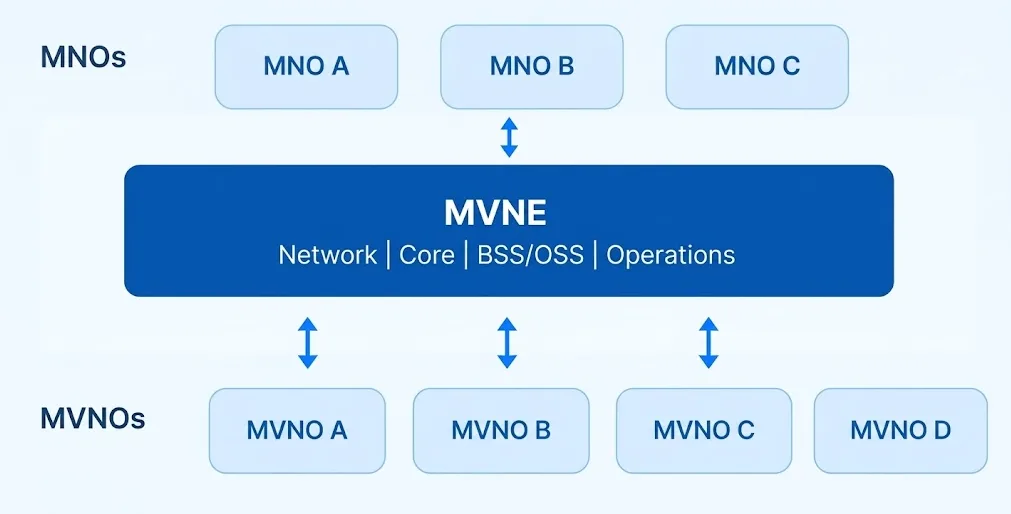
MVNE connects
network infrastructure with multiple MVNO business operations.
- Network Connectivity
- Multi-MVNO Enablement
- Service Integration
- Operational Support
How Does an MVNE Work?
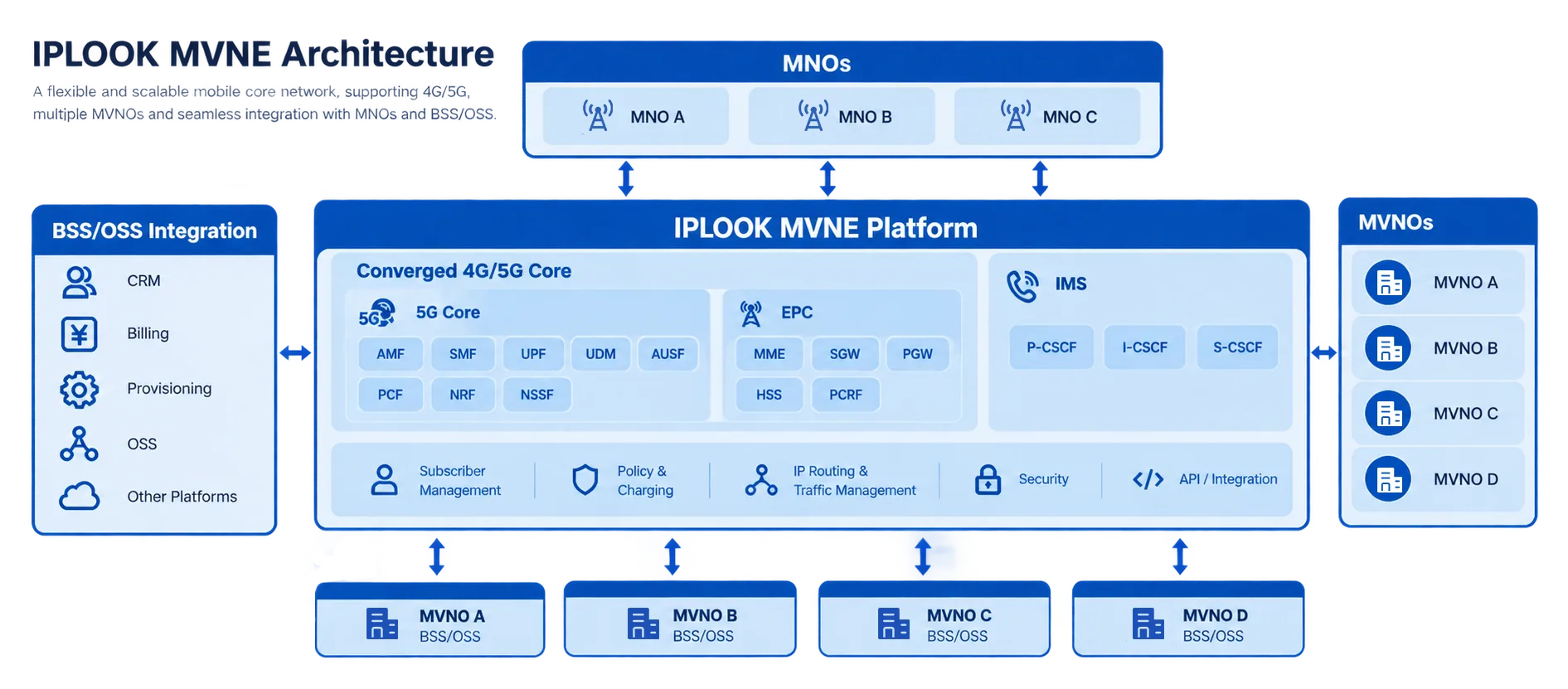
From MNO connectivity to service launch, IPLOOK's MVNE solution connects all key components for multiple MVNOs to operate efficiently and independently.
MNO Integration
Connect with one or multiple host MNO networks
Core Network Deployment
Deploy 4G EPC / 5G Core infrastructure
Multi-Tenant Configuration
Isolate and manage multiple MVNOs
BSS/OSS Integration
Connect with billing, CRM, provisioning and other platforms
Subscriber & SIM Management
Handle identities, SIM/eSIM and authentication
Service Activation
Enable data, voice, SMS and value-added services
MVNO Launch
Go live and scale operations
Support Different MVNO Business Models
We support a range of MVNO business models to match your market, control needs and operational goals.
Reseller
Minimal network control, relies on MNO infrastructure.
- MNO core & RAN
- MNO BSS/OSS
- Brand & customer management
Light MVNO
Partial network control and independent service management.
- Shared core or dedicated functions
- Own BSS/OSS (optional)
- Greater service flexibility
Full MVNO
Maximum control and independent network operation.
- Own core network
- Own BSS/OSS
- Full service control
Not sure which model fits your needs?
Our experts can help you evaluate the best MVNO model based on your market, scale and business goals.
Talk to an MVNE Expert

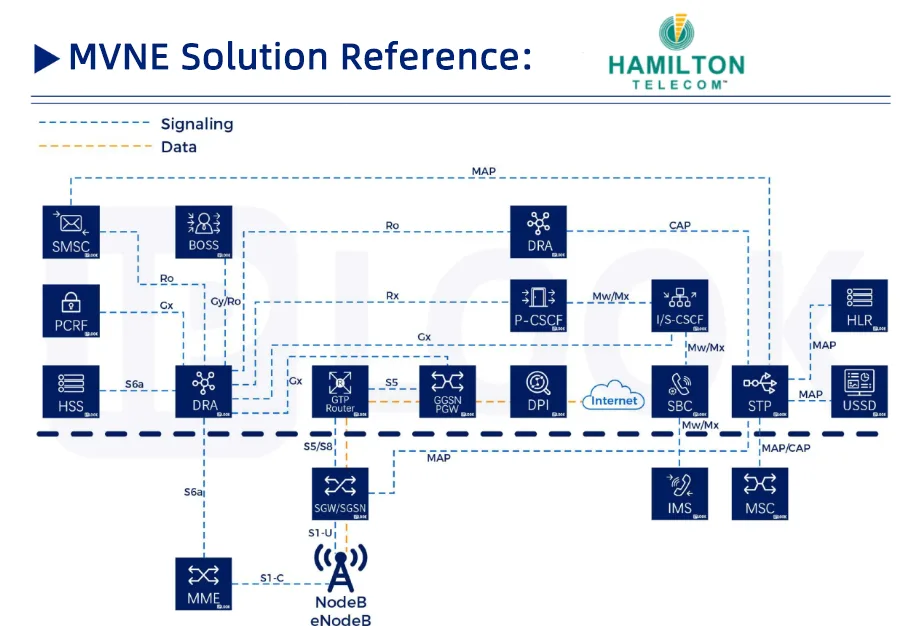
HAMILTON Telecom MVNE
IPLOOK deployed a geo-redundant mobile core infrastructure for Daily Telecom's MVNO operations, with high availability and scalable capacity across Italy.
Key Highlights
- 4G/5G core network
- Multi-MVNO support
- High availability
- Scalable architecture
MVNE Solution FAQ
Answers to common questions about MVNE architecture, MNO integration, multi-tenant operations, network functions, and deployment.
A Mobile Virtual Network Enabler (MVNE) provides the network infrastructure, software, integration, and operational capabilities that enable MVNOs to launch and manage mobile services. An MVNE can provide core network functions, subscriber management, connectivity with host MNO networks, charging and billing integration, and OSS/BSS capabilities, depending on the deployment model.
An MVNO provides mobile services to end users under its own brand while relying on an MNO for network access. Depending on its business model, an MVNO may operate some or all of its own network functions. An MVNE, by contrast, provides the technology, infrastructure, integration, and operational capabilities that enable one or more MVNOs to launch and manage mobile services.
An MVNE can use a multi-tenant architecture to support multiple MVNOs on shared network infrastructure. Each MVNO can have its own subscriber profiles, service configurations, policies, and operational requirements while sharing the underlying platform. This approach allows the MVNE to centralize network operations while supporting different MVNO brands and service models.
An MVNE connects its core network and service platforms with the host MNO network through standardized telecom interfaces and integration mechanisms. Depending on the network architecture, these can include interfaces based on Diameter, GTP, SIP, and other 3GPP-defined protocols. The integration scope depends on the host MNO, access technology, subscriber management model, and services required by the MVNO.
The network functions included in an MVNE deployment depend on the required architecture and service scope. IPLOOK can provide 4G EPC and 5G Core functions including MME, SGW, PGW, AMF, SMF, UPF, HSS/HLR, UDM/AUSF, PCF/PCRF, NRF, NSSF, and NEF. Additional capabilities such as IMS, voice services, charging, AAA, and OSS/BSS can be integrated according to the project requirements.
Yes. IPLOOK provides APIs and standardized network interfaces to support integration with existing OSS/BSS platforms, CRM systems, billing systems, network elements, and other third-party components. Its OSS/BSS capabilities include customer care, order management, subscriber and resource management, charging, billing, and payment functions, allowing the integration scope to be adapted to the operator's existing environment.
Yes. IPLOOK provides converged 4G EPC and 5G Core capabilities that support the evolution from LTE to 5G. Its converged core architecture combines 4G and 5G network functions and supports 5G Standalone (SA) and Non-Standalone (NSA) deployment scenarios. This allows an MVNE to maintain existing 4G services while introducing 5G capabilities as network and business requirements evolve.
Deployment time depends on the network architecture, host MNO integration, subscriber scale, OSS/BSS requirements, testing, data migration, and deployment environment. IPLOOK uses software-based and cloud-native network functions that can be deployed on cloud, virtualized infrastructure, or COTS servers. The actual project schedule is defined based on the required architecture, integration scope, testing plan, and commercial launch requirements.